
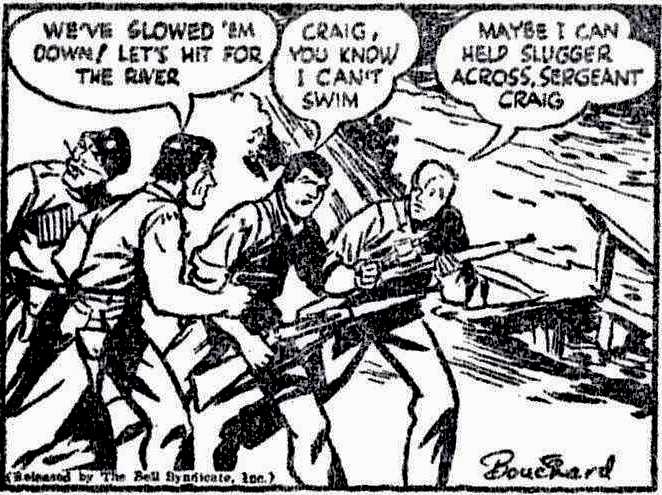
Stony Craig of the Marines

“Stony Craig of the Marines (aka Sergeant Craig) started its career in the pages of the Boston Traveler in August 1937. Sergeant Stony Craig and his subordinates, the loud-mouthed Wise, the resourceful Fink, and the handsome Hazard, were U.S. marines stationed in the American settlement in Shanghai. They seemed to be busier fighting the Japanese and their allies than protecting the American administrative headquarters. The similarities with Caniff’s Terry and the Pirates are obvious (there is even a woman guerilla-fighter, half-Russian, half-Chinese, by the name of Tania). If anything, artist/creator Don Dickson was even more emphatically anti-Japanese than Caniff, and he (correctly) foresaw the coming hostilities with Japan as early as 1939. To prepare for the day, Craig and his cohorts, in collusion with Intelligence Service officer Jeremy Blade (who looked like Clark Gable), did their best to harass the Japanese, blowing up their convoys, hijacking their arms shipments, and lending help to the guerillas. In between there were a few romantic interludes involving Hazard and his army nurse love, the blonde and demure Helen. Obscure as it is, Stony Craig was an excellent (and prescient) action strip, well-plotted, straight-forwardedly written and drawn in a loose, punchy, and winning style.” ... Maurice Horn, World Encyclopedia of Comics. In 1940 (following the closing of all foreign settlements in China by the Japanese authorities) Craig and company returned to the United States to combat spies and fifth columnists. Dickson also left in 1940 to join the marines. The strip was continued until 1944 by Gerry Bouchard. Bill Draut and Lin Streeter completed the run until 1946. The strip in credited to Frank Rentfrow, U.S.M.C., and he wrote the strip for most of its run. It was syndicated by the Bell Syndicate.

Volume 1 softcover fanzine reprints strips from 3/1/43-6/12/43, 11x8, 52 black & white pages. $8.95
Volume 2 - softcover, fanzine, reprints strips from 6/15/43-10/31/43, 11x8, 64 black & white pages. $8.95
Or buy both volumes for $14.95.

Stony Craig v.1
Stony Craig v.2
Stony Craig v.1-2


Blazing Combat

The legendary anti-war comic has now been collected in its entirety. Written by Archie Goodwin and drawn by such luminaries as Frank Frazetta, Wally Wood, John Severin, Alex Toth, Al Williamson, Russ Heath, Reed Crandall, and Gene Colan, Blazing Combat was originally published by independent comics publisher James Warren in 1965 and 1966. Following in the tradition of Harvey Kurtzman’s Two-Fisted Tales and Frontline Combat, Goodwin’s stories reflected the human realities and personal costs of war rather than exploiting the clichés of the traditional men’s adventure genre. They were among the best comics stories about war ever published. Blazing Combat ended after its fourth issue when military post exchanges refused to sell the title due to their perception that it was an anti-war comic. Their hostility was fueled by the depiction of the then-current Vietnam War, especially a story entitled “Landscape,” which follows the thoughts of a simple Vietnamese peasant rice-farmer who pays the ultimate price simply for living where he does. Writer Archie Goodwin and the original publisher James Warren discuss the death of Blazing Combat and market censorship as well as the creation of the series in exclusive interviews.

8x10, softcover, 208 black & white pages, $28.99.

Blazing Combat


Willie & Joe: The WWII Years

"The real war," said Walt Whitman, "will never get in the books." During World War II, the closest most Americans ever came to the "real war" was through the cartoons of Bill Mauldin, the most beloved enlisted man in the U.S. Army. Here, for the first time, Fantagraphics Books brings together Mauldin's complete works from 1940 through the end of the war. This collection of over 600 cartoons, most never before reprinted, is more than the record of a great artist: it is an essential chronicle of America's citizen-soldiers from peace through war to victory. Bill Mauldin knew war because he was in it. He had created his characters, Willie and Joe, at age 18, before Pearl Harbor, while training with the 45th Infantry Division and cartooning part-time for the camp newspaper. His brilliant send-ups of officers were pure infantry, and the men loved it. After wading ashore with his division on the first of its four beach invasions in July 1943, Mauldin and his men changed — and Mauldin's cartoons changed accordingly. Months of miserable weather, bad food, and tedium interrupted by the terror of intense bombing and artillery fire took its toll. By the year's end, virtually every man in Mauldin's original rifle company was killed, wounded, or captured. The wrinkles in Willie and Joe's uniforms deepened, the bristle on their faces grew, and the eyes — "too old for those young bodies," as Mauldin put it — betrayed a weariness that would remain the entire war. With their heavy brush lines, detailed battlescapes, and pidgin of army slang and slum dialect, Mauldin's cartoons and captions recreated on paper the fully realized world of the American combat soldier. Their dark, often insubordinate humor sparked controversy among army brass and incensed General George S. Patton, Jr. This is the first of several volumes publishing the best of Bill Mauldin's single panel strips from 1940 to 1991 (when he stopped drawing). His Willie & Joe cartoons are presented in a deluxe, beautifully designed two-volume slipcased edition of over 600 pages. The series is edited by Todd DePastino, whose Mauldin scholarship is on full display in a biography of the artist released in February 2008 from W.W. Norton. Willie & Joe contains an introduction and running commentary by DePastino, providing context for the drawings, pertinent biographical details of Mauldin's life, and occasional background on specific cartoons (such as the ones that made Patton howl).

8x11, 2 hardcover volumes in slipcase, 600 black & white pages, $65.00.

Willie & Joe


EC Archives: Frontline Combat
This volume reprints the first six complete issues (24 stories) of the comic book Frontline Combat. Frontline Combat was a bi-monthly, anthology war comic edited by Harvey Kurtzman and published by EC Comics. The first issue was cover dated July/August, 1951. Over a three-year span, the title ran for 15 issues, ending with the January, 1954 issue. Artists who contributed included Kurtzman and EC regulars such as John Severin, Jack Davis, Wally Wood, Russ Heath, George Evans and Will Elder. Kurtzman wrote the majority of the comic's stories with Jerry De Fuccio contributing one-page text stories and an occasional regular story. Kurtzman's editing approach to Frontline Combat was a stark contrast to EC editor Al Feldstein's style. Whereas Feldstein allowed his artists to draw the story in any manner they desired, Kurtzman developed detailed layouts for each story and required his artists to follow them exactly. Kurtzman's writing tended to have a lot less text in them than Feldstein's, which enabled the two war titles to be hand-lettered rather than machine-lettered like the remainder of EC's titles. Kurtzman was also dedicated to making the stories as historically accurate as possible and along with assistant De Fuccio put a lot of research into each story.
Hardcover, with dustjacket, 7x10, 212 full color pages. $49.95

EC Archives: Frontline Combat v.1


CLICK HERE to go to the
MAIN PAGE


Secure Site